
San Marino Population: 33,779
«  Previous Country | Next Country Previous Country | Next Country  » » | 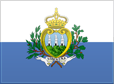 |
| History | |
| Geographically the third smallest state in Europe (after the Holy See and Monaco), San Marino also claims to be the world's oldest republic. According to tradition, it was founded by a Christian stonemason named MARINUS in A.D. 301. San Marino's foreign policy is aligned with that of the EU, although it is not a member; social and political trends in the republic track closely with those of its larger neighbor, Italy. |

|  |
| |
| Geography | |
| |
| Location: | Southern Europe, an enclave in central Italy |
| Geographic coordinates: | 43 46 N, 12 25 E |
| Area: | total: 61 sq km land: 61 sq km water: 0 sq km Size comparison: about one-third the size of Washington, DC |
| Land Boundaries: | total: 37 km border countries (1): Italy 37 km |
| Coastline: | 0 km (landlocked) |
| Maritime claims: | none (landlocked) |
| Climate: | Mediterranean; mild to cool winters; warm, sunny summers |
| Terrain: | rugged mountains |
| Natural resources: | building stone |
| Land use: | agricultural land: 16.7% (2011 est.) arable land: 16.7% (2011 est.) permanent crops: 0% (2011 est.) permanent pasture: 0% (2011 est.) forest: 0% (2011 est.) other: 83.3% (2011 est.) |
| Irrigated land: | 0 sq km (2012) |
| Natural hazards: | occasional earthquakes |
| Current Environment Issues: | air pollution; urbanization decreasing rural farmlands; water shortage |
| International Environment Agreements: | party to: Biodiversity, Climate Change, Desertification, Whaling signed, but not ratified: Air Pollution |
| ^Back to Top | |
| People | |
| |
| Nationality: | noun: Sammarinese (singular and plural) adjective: Sammarinese |
| Ethnic groups: | Sammarinese, Italian |
| Languages: | Italian |
| Religions: | Roman Catholic |
| Population: | 33,779 (July 2018 est.) |
| Age structure: | 0-14 years: 15.04% (male 2,687 /female 2,392) 15-24 years: 11.59% (male 2,046 /female 1,869) 25-54 years: 40.23% (male 6,391 /female 7,198) 55-64 years: 13.35% (male 2,215 /female 2,294) 65 years and over: 19.8% (male 3,006 /female 3,681) (2018 est.) |
| Median age: | total: 44.7 years male: 43.5 years female: 45.7 years (2018 est.) |
| Population growth rate: | 0.7% (2018 est.) |
| Birth rate: | 8.6 births/1,000 population (2018 est.) |
| Death rate: | 8.8 deaths/1,000 population (2018 est.) |
| Net migration rate: | 7.2 migrant(s)/1,000 population (2018 est.) |
| Urbanization: | urban population: 97.2% of total population (2018) rate of urbanization: 0.67% annual rate of change (2015-20 est.) |
| Major urban areas - population: | 4,000 SAN MARINO (2018) |
| Sex ratio: | at birth: 1.09 male(s)/female 0-14 years: 1.12 male(s)/female 15-24 years: 1.09 male(s)/female 25-54 years: 0.89 male(s)/female 55-64 years: 0.97 male(s)/female 65 years and over: 0.82 male(s)/female total population: 0.94 male(s)/female (2018 est.) |
| Infant mortality rate: | total: 4.3 deaths/1,000 live births male: 4.5 deaths/1,000 live births female: 4.1 deaths/1,000 live births (2018 est.) |
| Life expectancy at birth: | total population: 83.4 years male: 80.8 years female: 86.2 years (2018 est.) |
| Total fertility rate: | 1.51 children born/woman (2018 est.) |
| Physicians density: | 6.15 physicians/1,000 population (2014) |
| Hospital bed density: | 3.8 beds/1,000 population (2012) |
| HIV/AIDS - adult prevalence rate: | n/a |
| HIV/AIDS - people living with HIV/AIDS: | n/a |
| HIV/AIDS - deaths: | n/a |
| Education expenditures: | 2.4% of GDP (2011) |
| Literacy: | |
| School life expectancy (primary to tertiary education): | total: 15 years male: 15 years female: 16 years (2012) Unemployment, youth ages 15-24: total: 27.4% male: 21.4% female: 36% (2016 est.) |
| ^Back to Top | |
| Government | |
| |
| Country name: | conventional long form: Republic of San Marino conventional short form: San Marino local long form: Repubblica di San Marino local short form: San Marino etymology: named after Saint MARINUS, who in A.D. 301 founded the monastic settlement around which the city and later the state of San Marino coalesced |
| Government type: | parliamentary republic |
| Capital: | name: San Marino (city) geographic coordinates: 43 56 N, 12 25 E time difference: UTC+1 (6 hours ahead of Washington, DC, during Standard Time) daylight saving time: +1hr, begins last Sunday in March; ends last Sunday in October etymology: named after Saint MARINUS, who in A.D. 301 founded a monastic settlement around which the city and later the state of San Marino coalesced |
| Administrative divisions: | 9 municipalities (castelli, singular - castello); Acquaviva, Borgo Maggiore, Chiesanuova, Domagnano, Faetano, Fiorentino, Montegiardino, San Marino Citta, Serravalle |
| Independence: | 3 September 301 (traditional founding date) |
| National holiday: | Founding of the Republic (or Feast of Saint Marinus), 3 September (A.D. 301) |
| Constitution: | history: consists of several legislative instruments, chief among them the Statutes (Leges Statuti) of 1600 and the Declaration of Citizen Rights of 1974 amendments: proposed by the Great and General Council; passage requires two-thirds majority Council vote; Council passage by absolute majority vote also requires passage in a referendum; Declaration of Civil Rights amended several times, last in 2016 (2019) |
| Legal system: | civil law system with Italian civil law influences |
| Suffrage: | 18 years of age; universal |
| Executive branch: | chief of state: co-chiefs of state Captain Regent Nicola SELVA and Michele MURATORI (for the period 1 April 2019 - 30 September 2019) head of government: Secretary of State for Foreign and Political Affairs Nicola RENZI (since 27 December 2016) cabinet: Congress of State elected by the Grand and General Council elections/appointments: co-chiefs of state (captains regent) indirectly elected by the Grand and General Council for a single 6-month term; election last held in March 2019 (next to be held in September 2019); secretary of state for foreign and political affairs indirectly elected by the Grand and General Council for a single 5-year term; election last held on 4 December 2016 (next to be held by November 2021) election results: Nicola SELVA (Future Republic) and Michele MURATORI (Democratic Socialist Left) elected captains regent; percent of Grand and General Council vote - NA; Pasquale VALENTINI (PDCS) elected secretary of state for foreign and political affairs; percent of Grand and General Council vote - NA note: the captains regent preside over meetings of the Grand and General Council and its cabinet (Congress of State), which has 7 other members who are selected by the Grand and General Council; assisting the captains regent are 7 secretaries of state; the secretary of state for Foreign Affairs has some prime ministerial roles |
| Legislative branch: | description: unicameral Grand and General Council or Consiglio Grande e Generale (60 seats; members directly elected in single- and multi-seat constituencies by proportional representation vote in 2 rounds if needed; members serve 5-year terms) elections: last held on 20 November 2016 with a runoff held on 4 December 2016 (next to be held by November 2021) election results: percent of vote by coalition/party in the first round - San Marino First 41.7% (PDCS 24.5%, PS 7.7%, PSD 7.2%, other 2.3%), Adesso.sm 31.4% (SSD 12.1%, RF 9.6%, Civic 10 9.3%, other 0.5%), Democracy in Action 23.2% (RETE Movement 18.3%, Democratic Movement-San Marino Together 4.5%, other 0.4%), other 3.7%; percent of vote by coalition/party in the second round - Adesso.sm 57.9%, San Marino First 42.1%; seats by coalition/party - Adesso.sm 35 (SSD 14, RF 11, Civic 10 10), San Marino First 16 (PDCS 10, PS 3, PSD 3), Democracy in Action 9 (RETE Movement 8, Democratic Movement-San Marino Together 1); composition - men 46, women 14, percent of women 23.3% note - because no coalition won a majority in the first round, a runoff was held between the two coalitions that had received the greatest percent of the vote, San Marino First and Adesso.sm; Adesso.sm won the runoff, and the seats were reallocated |
| Judicial branch: | highest courts: Council of Twelve or Consiglio dei XII (consists of 12 members); note - the College of Guarantors for the Constitutionality and General Norms functions as San Marino's constitutional court judge selection and term of office: judges elected by the Grand and General Council from among its own to serve 5-year terms subordinate courts: first instance and first appeal criminal, administrative, and civil courts; Court for the Trust and Trustee Relations; justices of the peace or conciliatory judges |
| Political parties and leaders: | San Marino First (including Sammarinese Christian Democratic Party (Marco GATTI), Socialist Party (Augusto CASALI), Party of Socialists and Democratics (Paride ANDREOLI), Adesso.sm (including Democratic Socialist Left, Future Republic (Mario VENTURINI), Civic 10 (Matteo CIACCI), Democracy in Action (including The RETE Movement, Democratic Movement - San Marino Together) |
| International organization participation: | CE, FAO, IAEA, IBRD, ICAO, ICC (NGOs), ICCt, ICRM, IDA, IFRCS, ILO, IMF, IMO, Interpol, IOC, IOM (observer), IPU, ITU, ITUC (NGOs), LAIA (observer), OPCW, OSCE, Schengen Convention (de facto member), UN, UNCTAD, UNESCO, Union Latina, UNWTO, UPU, WHO, WIPO |
| National symbol(s): | three peaks each displaying a tower; national colors: white, blue |
| National anthem: | name: "Inno Nazionale della Repubblica" (National Anthem of the Republic) lyrics/music: no lyrics/Federico CONSOLO note: adopted 1894; the music for the lyric-less anthem is based on a 10th century chorale piece |
| Diplomatic representation in the US: | chief of mission: Ambassador Damiano BELEFFI (since 21 July 2017) chancery: 327 E 50th Street, New York, NY 10022, USA telephone: [1] (212) 751-1234 FAX: [1] (212) 751-1436 |
| Diplomatic representation from the US: | the United States does not have an Embassy in San Marino; the US Ambassador to Italy is accredited to San Marino, and the US Consulate general in Florence maintains day-to-day ties the US does not have an embassy in San Marino; the US Ambassador to Italy is accredited to San Marino |
| ^Back to Top | |
| Economy | |
San Marino's economy relies heavily on tourism, banking, and the manufacture and export of ceramics, clothing, fabrics, furniture, paints, spirits, tiles, and wine. The manufacturing and financial sectors account for more than half of San Marino's GDP. The per capita level of output and standard of living are comparable to those of the most prosperous regions of Italy. San Marino's economy contracted considerably in the years since 2008, largely due to weakened demand from Italy - which accounts for nearly 90% of its export market - and financial sector consolidation. Difficulties in the banking sector, the global economic downturn, and the sizable decline in tax revenues all contributed to negative real GDP growth. The government adopted measures to counter the downturn, including subsidized credit to businesses and is seeking to shift its growth model away from a reliance on bank and tax secrecy. San Marino does not issue public debt securities; when necessary, it finances deficits by drawing down central bank deposits. The economy benefits from foreign investment due to its relatively low corporate taxes and low taxes on interest earnings. The income tax rate is also very low, about one-third the average EU level. San Marino continues to work towards harmonizing its fiscal laws with EU and international standards. In September 2009, the OECD removed San Marino from its list of tax havens that have yet to fully adopt global tax standards, and in 2010 San Marino signed Tax Information Exchange Agreements with most major countries. In 2013, the San Marino Government signed a Double Taxation Agreement with Italy, but a referendum on EU membership failed to reach the quorum needed to bring it to a vote. | |
| GDP (purchasing power parity): | $2.064 billion (2017 est.) $2.026 billion (2016 est.) $1.983 billion (2015 est.) note: data are in 2017 dollars |
| GDP (official exchange rate): | $1.643 billion (2017 est.) |
| GDP - real growth rate: | 1.9% (2017 est.) 2.2% (2016 est.) 0.6% (2015 est.) |
| GDP - per capita (PPP): | $59,000 (2017 est.) $59,600 (2016 est.) $58,300 (2015 est.) note: data are in 2017 dollars GDP - composition, by end use: household consumption: n/a (2011 est.) government consumption: n/a (2011 est.) investment in fixed capital: n/a (2011 est.) investment in inventories: n/a (2011 est.) exports of goods and services: 176.6% (2011) imports of goods and services: -153.3% (2011) GDP - composition, by sector of origin: agriculture: 0.1% (2009) industry: 39.2% (2009) services: 60.7% (2009) |
| Agriculture - products: | wheat, grapes, corn, olives; cattle, pigs, horses, beef, cheese, hides |
| Industries: | tourism, banking, textiles, electronics, ceramics, cement, wine |
| Industrial production growth rate: | -1.1% (2012 est.) |
| Labor force: | 21,960 (September 2013 est.) |
| Labor force - by occupation: | agriculture: 0.2% industry: 33.5% services: 66.3% (September 2013 est.) |
| Unemployment rate: | 8.1% (2017 est.) 8.6% (2016 est.) |
| Population below poverty line: | n/a |
| Household income or consumption by percentage share: | lowest 10%: n/a highest 10%: n/a |
| Budget: | revenues: 667.7 million (2011 est.) expenditures: 715.3 million (2011 est.) |
| Taxes and other revenues: | 40.6% (of GDP) (2011 est.) Budget surplus (+) or deficit (-): -2.9% (of GDP) (2011 est.) |
| Public debt: | 24.1% of GDP (2017 est.) 22.5% of GDP (2016 est.) |
| Fiscal year: | calendar year |
| Inflation rate (consumer prices): | 1% (2017 est.) 0.6% (2016 est.) |
| Current account balance: | $0 (2017 est.) $0 (2016 est.) |
| Exports: | $3.827 billion (2011 est.) $2.576 billion (2010 est.) |
| Exports - commodities: | building stone, lime, wood, chestnuts, wheat, wine, baked goods, hides, ceramics |
| Imports: | $2.551 billion (2011 est.) $2.132 billion (2010 est.) |
| Imports - commodities: | wide variety of consumer manufactures, food, energy |
| Reserves of foreign exchange and gold: | $392 million (2014 est.) $539.3 million (2013 est.) |
| Debt - external: | n/a |
| Market value of publicly traded shares: | n/a |
| Exchange rates: | euros (EUR) per US dollar - 0.885 (2017 est.) 0.903 (2016 est.) 0.9214 (2015 est.) 0.885 (2014 est.) 0.7634 (2013 est.) |
| ^Back to Top | |
| Energy | |
| |
| ^Back to Top | |
| Communications | |
| |
| Cellular Phones in use: | total subscriptions: 38,000 subscriptions per 100 inhabitants: 113 (2017 est.) |
| Telephone system: | general assessment: automatic telephone system completely integrated into Italian system (2018) domestic: fixed-line 47 per 100 and mobile-cellular teledensity 113 telephones per 100 persons (2018) international: country code - 378; connected to Italian international network |
| Broadcast media: | state-owned public broadcaster operates 1 TV station and 3 radio stations; receives radio and TV broadcasts from Italy (2019) |
| Internet country code: | .sm |
| Internet users: | total: 17,200 percent of population: 52.6% (July 2016 est.) |
| ^Back to Top | |
| Transportation | |
| |
| Roadways: | total 292 km (2006) paved: 292 km (2006) |
| ^Back to Top | |
| Military | |
| |
| Defense is the responsibility of Italy | |
| Military branches: | no regular military forces; voluntary Military Corps (Corpi Militari) performs ceremonial duties and limited police support functions (2010) |
| Military service age and obligation: | 18 is the legal minimum age for voluntary military service; no conscription; government has the authority to call up all San Marino citizens from 16-60 years of age to service in the military (2012) |
| ^Back to Top | |
| Transnational Issues | |
| |
| Disputes - International: | none |
| ^Back to Top | |
«
Previous Country | Next Country »
Source: CIA - The World Factbook